
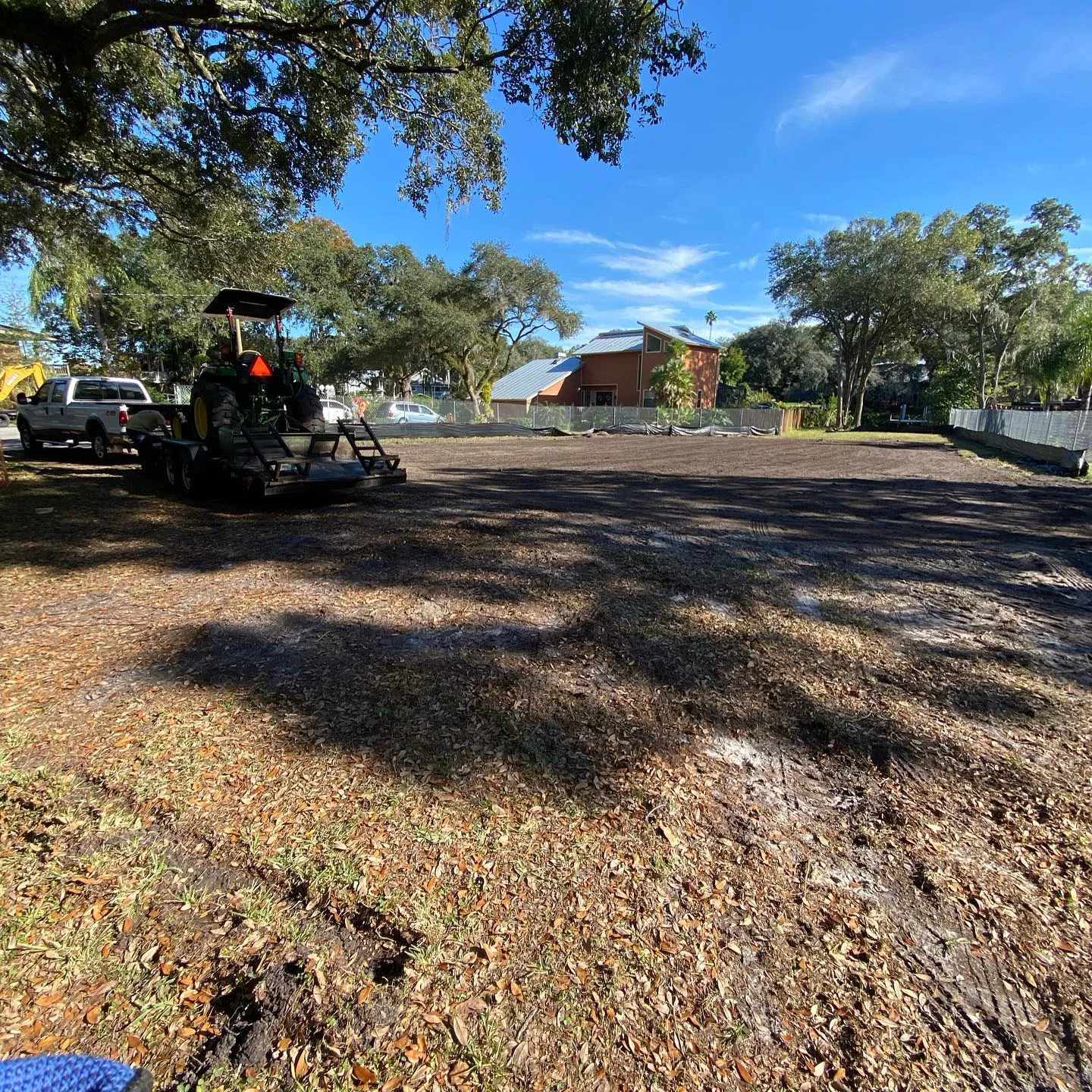
How much does land clearing cost per acre in Florida?
Published 2026 cost guides put land clearing in the Tampa Bay area at roughly $1,200 to $6,000 per acre. Light brush sits near the bottom. Dense pine and hardwood with stump removal sits at the top. Most residential lots land between $2,500 and $4,500 an acre.
Every figure on this page is market data from published cost guides. None of it is a quote from us. We price land clearing in Tampa after seeing the property in person, and that visit is free.
What does clearing cost by lot size?
Price climbs with acreage, but not in a straight line. A half acre rarely costs half of what an acre costs. Hauling machines to the site costs the same either way. Bigger tracts often earn a discount. The OWNR OPS 2026 cost guide breaks it down like this.
| Lot size | Light brush | Wooded | Heavy timber |
|---|---|---|---|
| 1/2 acre | $800 to $1,500 | $1,500 to $3,000 | $2,500 to $4,500 |
| 1 acre | $1,500 to $2,500 | $3,000 to $4,500 | $4,500 to $6,000+ |
| 5 acres | $7,500 to $12,500 | $13,500 to $20,000 | $20,000 to $30,000+ |
| 10 acres | $13,000 to $22,000 | $25,000 to $38,000 | $38,000 to $60,000+ |
Run the 5-acre math and the per-acre rate drops. Wooded ground at $13,500 to $20,000 for 5 acres works out to $2,700 to $4,000 an acre. That is under the one-acre rate. The same guide credits a 10 to 20 percent volume discount past 5 acres. The crew moves in once and stays.
Tampa numbers sit inside that band. Local contractor guides quote $1,200 to $6,000 per acre here. A half-acre lot with moderate palmetto and brush is commonly quoted at $1,500 to $2,500. HomeAdvisor puts the national half-acre range wider, at $250 to $2,800.
What drives the price up or down?
Four things move the number more than anything else. How thick the growth is. How big the trunks are. Where the debris ends up. And whether a machine can reach the work. In Florida, ground conditions sit under all of it.
Density and trunk size set the baseline. Tampa Bay guides price brush and trees under 6 inches at $1,200 to $2,500 an acre. A typical Florida mix with 12 to 18 inch trunks runs $2,500 to $4,500. Mature hardwood and dense pine push past $4,500.
Saw palmetto is its own line item. The roots run deep and break off, so the machine works the same ground twice. Florida contractor guides flag palmetto as a main reason lots here price above the national average.
Debris is the other big swing. National guides put haul-off at $500 to $2,000 an acre. One Tampa Bay guide puts trucking in Hillsborough County at $500 to $1,500 an acre. That sits on top of the clearing price. The cost is truck time and tipping fees, so a contractor running its own dump trucks controls it better.
Clearing does not include leveling the ground. Published grading rates run $0.50 to $2.00 per square foot. Low spots usually need fill dirt brought in and spread. Budget land grading as a separate line from day one.
Is forestry mulching cheaper than clear and grub?
Usually yes, on the first pass. A mulcher grinds brush and small trees into chips that stay on the ground. Nothing gets hauled, so the disposal line disappears. Published rates run $1,500 to $4,000 an acre, about 20 to 40 percent under traditional clearing. The roots stay put.
| Method | Published cost per acre | What you get |
|---|---|---|
| Forestry mulching | $1,500 to $4,000 | Brush ground into chips, roots stay in place |
| Traditional clearing | $2,000 to $6,000 | Trees down, debris piled for removal |
| Debris haul-off (add) | $500 to $2,000 | Trucking and disposal off site |
| Stump grinding (per stump) | $150 to $500 | Ground 2 to 4 inches below grade |
| Full stump removal (per stump) | $250 to $800 | Root ball pulled out of the ground |
Those method ranges come from the OWNR OPS mulching guide and Tampa Bay contractor pricing.
A mulcher cuts 2 to 4 inches below grade. The root mass stays in the sand. For a trail or a pasture, that works fine. Under a house pad it does not, because buried wood rots and the pad settles years later. If you plan to build, the grubbing gets done eventually, and paying for clearing twice is the risk. Lots headed for construction go from clearing into site preparation and compaction.
What is the cheapest way to clear land?
Mulching in place, when it fits the goal. It deletes the two biggest line items, trucking and disposal. Burning costs less on rural acreage where it is permitted, though that rarely works on Tampa lots near houses. Selling merchantable pine offsets part of the bill on larger tracts.
Timing is the quiet lever. Tampa Bay guides suggest scheduling clearing for late winter or early spring. Brush is thinner, the ground is firm, and summer regrowth has less of a head start.
How long does it take to clear 1 acre of wooded land?
Contractor guides put a lightly wooded acre at a few hours to one working day. Moderate growth runs one to two working days. Dense woods with stumps and haul-off take three to five days or longer. Those counts cover field work only, not permits or rain delays.
The National Weather Service puts the West Central Florida rainy season at May 25 through October 10. Saturated sand and muck bog machines down. A job that takes two days in March can take a week in August. Ruts left in wet ground cost money to fix.
If a structure is still standing on the lot, that comes down first. Our Tampa house demolition cost guide covers those numbers.
Do I need a permit to clear my own land?
In unincorporated Hillsborough County, usually yes. The county requires a natural resources permit before land alteration. It defines that as removing vegetation or changing topography by grubbing, tree removal, clearing, grading, filling or excavating. Work to maintain existing grounds is excepted.
Tree removal is a separate permit. Hillsborough County charges $81.65 for any number of trees on a parcel up to 5 acres. Add $24.93 per additional acre. Applications go through the county’s HillsGovHub portal, and permits stay valid for two years.
Grand Oaks get stricter treatment. The county defines one as an oak with at least 34 inches diameter at breast height. It also needs a condition rating of good or better, plus 175 points across trunk, height and crown. Those must be preserved unless the county authorizes removal. Replacement ratios run 1:1 up to 2:1 by trunk size.
Some species are exempt from the tree permit. The county’s list includes Brazilian pepper, Australian pine, camphor, chinaberry, Chinese tallow and queen palm. Trees inside a wetland are regulated separately.
Gopher tortoises add a step. FWC says tortoises must be relocated before any land clearing or development takes place. Owners need an FWC permit before moving them. A burrow survey happens before the machines do.
Tampa, Plant City and Temple Terrace run their own tree rules, and so do Pinellas and Pasco counties. Check with the department that covers your parcel before a machine shows up.
What will clearing your lot actually cost?
Somewhere in those ranges, depending on what is growing and where the trucks can park. The only way to get a real number is for someone to walk the lot. They count what has to come out and check how the ground drains. We do that at no charge.
Call (813) 453-5883 or send us the details. We cover Hillsborough, Pinellas and Pasco counties.