
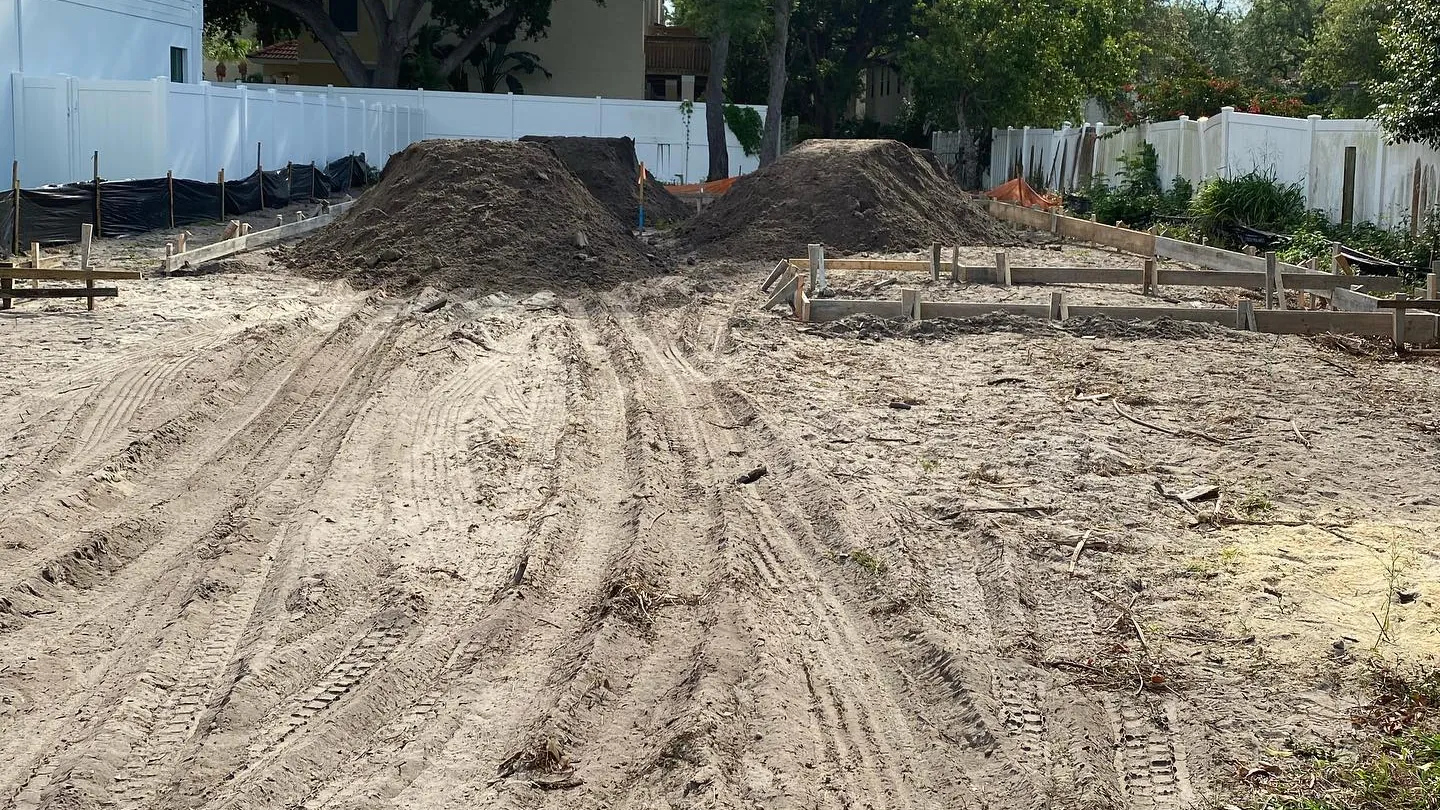
How much does excavation cost in Tampa?
Most homeowners pay $1,659 to $6,715 for residential excavation, according to Angi’s cost guide, updated in September 2026. HomeGuide prices the digging itself at $2.50 to $15.00 per cubic yard. Both are national ranges, and the wet, sandy soils found in Hillsborough County can push a dig toward the top.
What does excavation cost per cubic yard?
HomeGuide’s excavation guide, dated February 5, 2026, puts digging at $2.50 to $15.00 per cubic yard. The rate depends on the soil type, depth, terrain and obstructions. HomeGuide’s soil table includes labor and equipment in each rate:
- Light soil: $2.50 to $6.00 per cubic yard
- Average soil: $6.00 to $10.00 per cubic yard
- Heavy or wet soil, or loose rock: $10.00 to $15.00 per cubic yard
- Rock that needs a jackhammer: $50 to $200 or more per cubic yard
Angi’s guide puts the 2026 national average for a residential excavation job at $3,979. Angi ties the spread to project type, soil conditions and site access. It says rocky or clay-heavy soil can add $200 to $1,200 to a job.
Every dollar figure on this page is a national range from a published cost guide. Your own number depends on your lot and the job. We run excavators in several sizes, so the machine fits the lot. For a price on your own dig, ask us about excavation in Tampa Bay.
What does an excavator cost per hour with an operator?
HomeGuide puts operators with their own mini excavator, backhoe or skid steer at $100 to $300 per hour. An operator without a machine runs $50 to $150 per hour. Most operators charge a minimum of one day or eight hours.
Other guides come in lower. Angi prices equipment with an operator at $100 to $250 per hour. Angi’s pool guide lists professional excavation teams at $40 to $180 per hour. HomeGuide adds that many contractors set minimum project fees of $500 to $800.
Machine size moves the hourly rate. HomeAdvisor says a compact skid steer or backhoe costs $100 per hour with an operator. If a full-size excavator fits the driveway, it says to plan on roughly 50 percent more per hour. The bigger bucket can cut overall labor time.
Tight sites cost more. HomeGuide says costs rise when crews work around buildings or in tight spaces that need smaller equipment. A backyard pool hole reached through a side gate is one example.
How much does excavation cost by job?
Cost guides also price whole jobs. This table sets the main published ranges side by side.
| Job type | Published range | What drives it |
|---|---|---|
| Digging, per cubic yard | $2.50 to $15.00 (HomeGuide) | Soil type and depth |
| Excavator with operator, per hour | $100 to $300 (HomeGuide) | Machine size and day minimums |
| Foundation for a new home | $1,500 to $10,000 (HomeGuide) | Foundation size and depth |
| Pool hole for a new pool | $500 to $3,020 (Angi) or $1,500 to $5,000 (HomeGuide) | Pool size and depth |
| Trenching | $5 to $12 per linear foot (HomeGuide) | Trench length and site access |
| Hauling dirt away | $8 to $25 per cubic yard (Angi) | Haul distance and truck access |
HomeGuide puts home site excavation at $1,500 to $10,000, depending on the foundation size, depth and terrain. Angi’s project table lists new construction at the same $1,500 to $10,000. The foundation dig is one part of lot prep and pad work, which we handle before the foundation goes in.
Pool hole ranges sit far apart. Angi’s pool guide, updated October 19, 2026, says $500 to $3,020, with pool size and depth setting the total. HomeGuide says $1,500 to $5,000 when the soil is soft and free of obstructions. HomeGuide adds that a hard to reach site or rock can raise it to $15,000 to $20,000.
Trenching runs $5 to $12 per linear foot, per HomeGuide. For a whole trenching job, its earthwork table lists $500 to $1,200. Angi says trench length and site access are the main factors that move the price.
How does Tampa Bay soil change the price?
USDA’s description of the Seffner soil series gives a local picture. Its type location is in Hillsborough County, about a mile south of Plant City. The soil formed in sandy marine sediments and is somewhat poorly drained. Nearby soils run wetter, since USDA lists Myakka and Smyrna soils as poorly or very poorly drained.
On this soil, water sits close to the surface. In most years, the Seffner water table is within 18 to 42 inches for 2 to 4 months. In some years it rises to 10 to 20 inches for up to 2 weeks. The sizes in Angi’s pool table work out to about 6 feet deep, well below those levels.
That matters for price. HomeGuide’s heavy or wet soil row costs more than its light soil row. Angi’s pool guide prices sand at $8 to $40 per cubic yard, against $8 to $25 for standard dirt. It says the hole walls in sand may need support to keep them from collapsing back in.
Hard layers can turn up too. The Seffner description says some spots have cemented layers deeper than 40 inches. If a dig hits rock, HomeGuide says costs can jump to $15,000 to $20,000 or more.
Should you haul the dirt off or keep it on the lot?
Every hole leaves a pile of dirt that has to go somewhere. HomeGuide says costs go up when dirt is trucked to or from the site instead of moved on site. HomeAdvisor suggests reusing clean fill on site for landscaping instead of paying to haul it away. On a new build, HomeGuide suggests asking how the foundation dirt can go back in as backfill.
Hauling prices vary widely between guides. Angi puts hauling at $8 to $25 per cubic yard. It says easy access for a dump truck keeps the price near the low end.
HomeGuide puts moving dirt at $140 to $230 per cubic yard, or $1,400 to $2,300 per dump truck load. Ask each contractor how haul off is priced, so the quotes match.
A new pad or a backfilled foundation may need more dirt brought in. HomeGuide lists fill dirt at $5 to $25 per cubic yard on average. Our own dump trucks handle dirt hauling and backfill on Tampa Bay jobs. Our guide to the price of fill dirt in Tampa covers that side.
Do you need a permit or an 811 call before you dig?
Florida law calls for notice at least 2 full business days before any excavation. The companies that run buried lines then mark where those lines go. HomeGuide gives the same advice: call 811 so buried lines get marked before digging starts.
Buried lines also add cost. HomeGuide says digging around buried pipes or utility lines takes extra caution, which adds labor time.
Permits are a separate step. HomeGuide puts an excavation permit at $50 to $400, depending on the project size and location. It says most cities require a permit for any earthmoving project.
Angi’s pool guide says a permit is required for any in-ground or semi-inground pool. Angi’s main guide says a land survey is usually part of the permit process, at about $400 to $550.
How do you compare excavation quotes?
Quotes only compare when they price the same job. HomeGuide says a contractor must visit the site in person to give an accurate estimate. It suggests getting at least three quotes.
- Give every contractor the same size and depth for the hole or trench.
- Ask if the price is per cubic yard, per hour or for the whole job.
- Ask about any minimum charge or day minimum.
- Ask whether hauling the dirt away is in the price.
- Ask whether backfill and final grading are included.
- Ask whether site cleanup is part of the job.
- Ask what happens to the price if the dig hits water or rock.
- Ask whether the hole walls will need support in loose sand.
- Ask who places the 811 call and who pulls the permit.
- Get the scope and price in writing before the work begins.